
Table of Contents
ToggleThe Future of Commercial Real Estate Marketing Digital Marketing for Commercial Real Estate in 2027
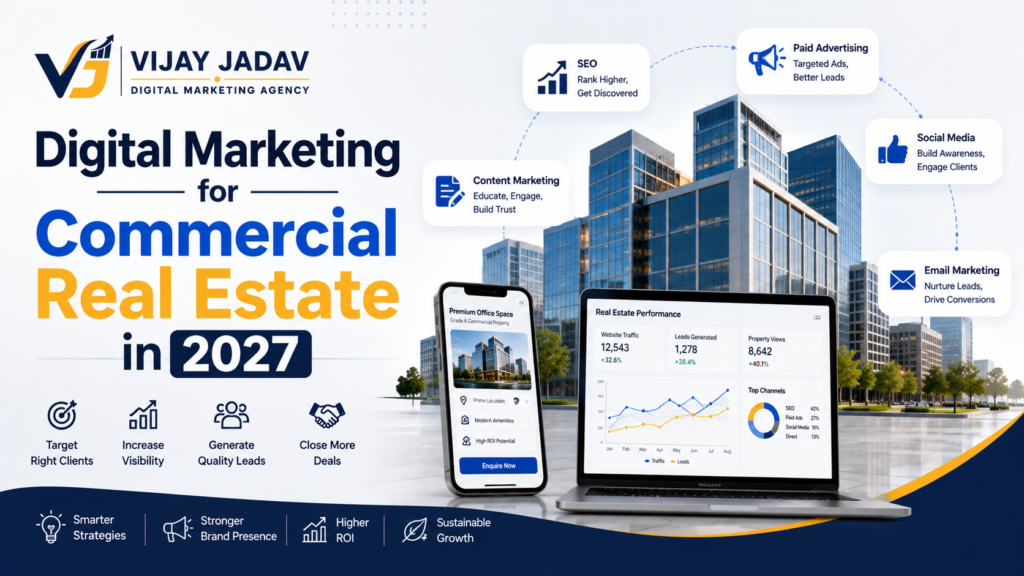
The future of commercial real estate marketing in 2027 is driven by AI, data analytics, personalized customer experiences, and digital-first strategies. Companies that invest in SEO, high-quality websites, paid advertising, video marketing, and marketing automation will generate better-qualified leads, shorten sales cycles, and build stronger investor confidence.
Commercial real estate marketing has changed dramatically over the last few years. Buyers, investors, tenants, and corporate decision-makers no longer rely only on traditional brokers or newspaper advertisements to discover commercial properties. Instead, they research online, compare multiple properties, watch virtual tours, read reviews, and evaluate developers before making contact. This shift means digital marketing is no longer optional—it has become one of the most important growth strategies for commercial real estate businesses.
In Ahmedabad, where commercial developments continue to expand across business districts, industrial zones, and retail corridors, companies need a strong digital presence to remain competitive. A professional website, optimized local SEO, informative content, targeted advertising, and social media engagement all work together to attract high-quality prospects. Businesses that consistently educate their audience through blogs, market insights, and investment guides establish greater trust than companies focused only on selling properties.
Artificial intelligence is also transforming how commercial real estate marketers understand customer behavior. AI-powered tools can identify buyer intent, personalize marketing campaigns, predict lead quality, and automate follow-up communication. Instead of sending generic emails, businesses can now deliver relevant property recommendations based on a user’s browsing history, investment preferences, or previous inquiries.
Another major trend is the growing importance of visual content. Investors want immersive experiences before scheduling site visits. Drone videos, 3D walkthroughs, interactive floor plans, and virtual property tours help reduce uncertainty and increase engagement.
Companies should also invest in educational content. Publishing market reports, investment guides, commercial leasing advice, and neighborhood analysis helps position the business as an industry authority. This approach aligns with Google’s EEAT guidelines while also improving visibility in AI-powered search engines like ChatGPT, Gemini, and Perplexity.Digital Marketing for Commercial Real Estate in 2027
Biggest Challenges in Commercial Property Marketing
Commercial property marketing is challenging because decision-making cycles are longer, target audiences are smaller, competition is higher, and buyers require significant trust before investing. A strategic digital marketing plan helps overcome these challenges by improving visibility, lead quality, and customer engagement.
Unlike residential real estate, commercial property transactions often involve larger investments, multiple stakeholders, legal considerations, and extended evaluation periods. Investors carefully compare properties, study market conditions, assess future growth potential, and evaluate return on investment before making a decision. As a result, marketers must focus on building trust throughout the buyer journey rather than expecting quick conversions.
One of the biggest challenges is generating qualified leads. Many companies receive website inquiries from users who are only browsing or researching, resulting in wasted sales efforts. Effective lead qualification through optimized landing pages, CRM systems, and automated follow-up sequences helps sales teams prioritize serious prospects.
Another common challenge is standing out in a competitive market. Hundreds of developers promote office spaces, retail units, industrial warehouses, and commercial projects using similar messaging. Businesses that provide detailed market insights, investment analysis, customer success stories, and educational content are more likely to gain credibility and attract decision-makers.
Budget allocation is another concern. Many companies spend heavily on advertising without measuring campaign performance. Successful marketers continuously analyze traffic sources, conversion rates, cost per lead, and return on ad spend before increasing budgets.
Trust is equally important. Investors want transparency, professional branding, verified testimonials, high-quality visuals, and accurate project information. Outdated websites, missing contact details, or inconsistent branding can reduce credibility and negatively affect conversion rates.
Challenge | Effective Solution |
Low-quality leads | SEO + Lead Qualification |
High competition | Content Marketing + Branding |
Long buying cycle | Email Nurturing + CRM |
Low website conversions | Conversion Rate Optimization |
Limited trust | Reviews, Case Studies, Testimonials |
Poor ROI | Performance Tracking & Analytics |
Companies that consistently educate prospects instead of aggressively selling build stronger relationships and achieve higher long-term conversion rates.
Building a High-Converting Real Estate Website
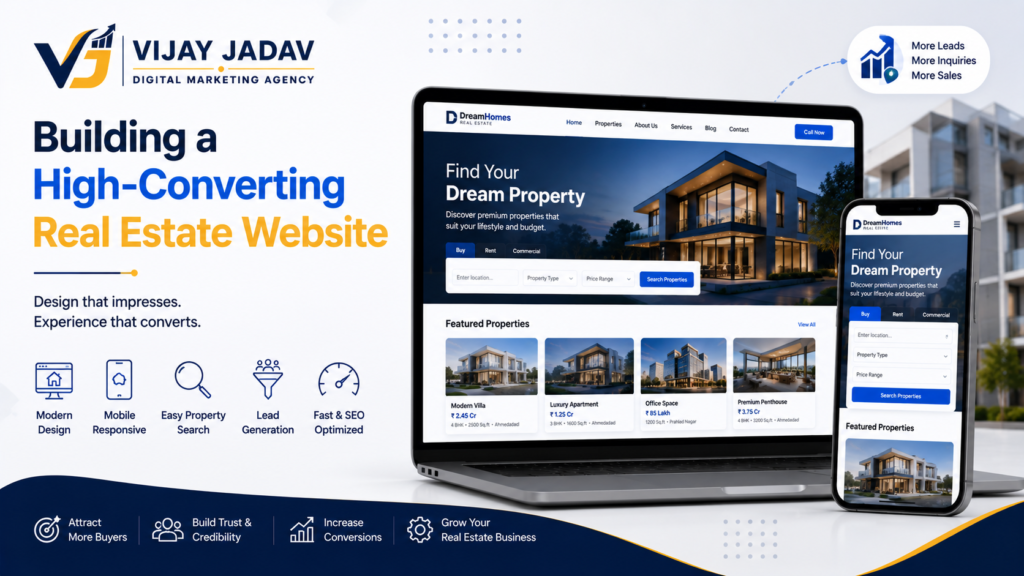
A high-converting commercial real estate website, built with the expertise of the Best Digital Marketing Agency in Ahmedabad, combines fast loading speed, professional design, SEO optimization, compelling property information, clear calls-to-action, and a seamless user experience. Every page should help visitors quickly find information and confidently take the next step.Digital Marketing for Commercial Real Estate in 2027
Your website is often the first impression potential investors, tenants, or business owners have of your company. In commercial real estate, credibility matters. A modern, responsive, and professionally designed website builds confidence before any conversation begins. Visitors should immediately understand what types of properties you offer, where you operate, and how they can contact your team.
Homepage messaging should clearly communicate your value proposition with a strong headline, relevant imagery, and visible call-to-action buttons such as Schedule a Site Visit, Request Property Details, or Talk to an Expert. Navigation should be simple, allowing users to explore office spaces, industrial properties, retail units, investment opportunities, and available listings without confusion.
Property pages deserve special attention. Instead of displaying only images and pricing, include detailed specifications, floor plans, amenities, nearby infrastructure, transportation access, ROI potential, downloadable brochures, and virtual tours. This additional information reduces buyer uncertainty and increases engagement.
Technical SEO is equally important. Fast loading pages, mobile responsiveness, HTTPS security, optimized images, structured data, and clean URLs improve both user experience and search engine rankings. Google also rewards websites that demonstrate expertise through informative blogs, FAQs, market reports, and educational resources.
Lead capture should be strategically placed throughout the website using inquiry forms, WhatsApp integration, callback requests, newsletter subscriptions, and downloadable investment guides. Every conversion opportunity should be easy to access without disrupting the browsing experience.
Finally, continuous testing is essential. Monitor visitor behavior using analytics tools, identify pages with high exit rates, and optimize layouts, headlines, and calls-to-action based on real user data. Even small improvements in usability can significantly increase lead generation.
Building a High-Converting Real Estate Website
A high-converting commercial real estate website combines fast loading speed, professional design, SEO optimization, compelling property information, clear calls-to-action, and a seamless user experience. Every page should help visitors quickly find information and confidently take the next step.
Your website is often the first impression potential investors, tenants, or business owners have of your company. In commercial Digital Marketing for Real Estate credibility matters. A modern, responsive, and professionally designed website builds confidence before any conversation begins. Visitors should immediately understand what types of properties you offer, where you operate, and how they can contact your team.
Homepage messaging should clearly communicate your value proposition with a strong headline, relevant imagery, and visible call-to-action buttons such as Schedule a Site Visit, Request Property Details, or Talk to an Expert. Navigation should be simple, allowing users to explore office spaces, industrial properties, retail units, investment opportunities, and available listings without confusion.
Property pages deserve special attention. Instead of displaying only images and pricing, include detailed specifications, floor plans, amenities, nearby infrastructure, transportation access, ROI potential, downloadable brochures, and virtual tours. This additional information reduces buyer uncertainty and increases engagement.
Technical SEO is equally important. Fast loading pages, mobile responsiveness, HTTPS security, optimized images, structured data, and clean URLs improve both user experience and search engine rankings. Google also rewards websites that demonstrate expertise through informative blogs, FAQs, market reports, and educational resources.
Lead capture should be strategically placed throughout the website using inquiry forms, WhatsApp integration, callback requests, newsletter subscriptions, and downloadable investment guides. Every conversion opportunity should be easy to access without disrupting the browsing experience.
Finally, continuous testing is essential. Monitor visitor behavior using analytics tools, identify pages with high exit rates, and optimize layouts, headlines, and calls-to-action based on real user data. Even small improvements in usability can significantly increase lead generation.
SEO Strategies for Commercial Real Estate
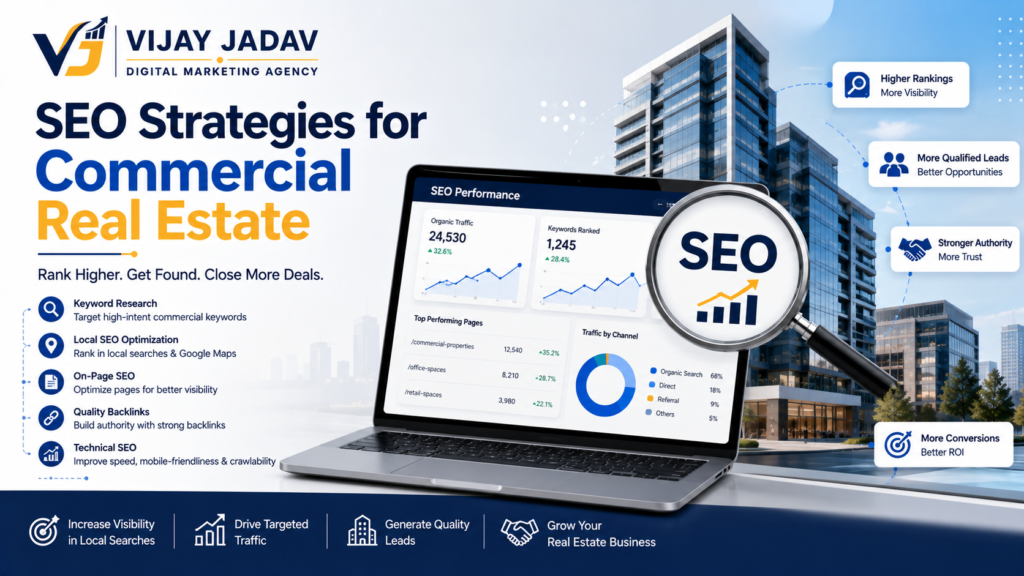
SEO for commercial real estate helps your website rank higher on Google when investors, business owners, and tenants search for office spaces, retail shops, warehouses, or commercial properties. A strong SEO strategy combines keyword optimization, high-quality content, local SEO, technical improvements, and authority building to generate consistent organic leads.
Search engine optimization remains one of the highest ROI digital marketing channels for commercial real estate in 2027. Unlike paid advertising, SEO continues driving qualified traffic long after content is published. Decision-makers often spend weeks or months researching before contacting a developer, making organic visibility essential throughout the buying journey.
Start with comprehensive keyword research. Focus on commercial intent keywords such as Commercial Real Estate Marketing, Commercial Property for Sale in Ahmedabad, Office Space for Lease Ahmedabad, Industrial Warehouse Ahmedabad, and Commercial Real Estate SEO. Support these with long-tail keywords that answer specific questions buyers ask, increasing your chances of appearing in Google’s Featured Snippets and AI Overviews.
Create dedicated landing pages for every service, property category, and location. For example, instead of one generic property page, develop separate optimized pages for office spaces, retail shops, industrial parks, warehouses, and investment properties. Include detailed descriptions, FAQs, pricing information where appropriate, maps, and nearby landmarks.
Technical SEO is equally important. Ensure fast page speed, mobile responsiveness, structured data (Schema Markup), secure HTTPS connections, optimized images, XML sitemaps, and clean URL structures. These improvements help search engines crawl and understand your website more effectively.
Local SEO is especially valuable for businesses targeting Ahmedabad. Optimize your Google Business Profile, collect genuine customer reviews, maintain consistent business information across directories, and publish localized content such as commercial property trends in SG Highway, Prahlad Nagar, GIFT City, and other business hubs.
Backlinks from trusted industry websites, business associations, and reputable publications further strengthen domain authority. Publishing market reports, investment insights, and expert analysis naturally attracts citations and links while reinforcing Google’s EEAT signals.
SEO Strategy | Business Benefit |
Keyword Research | Better search visibility |
Local SEO | More Ahmedabad-based leads |
Technical SEO | Improved rankings and user experience |
Content Marketing | Builds authority and trust |
Schema Markup | Better search appearance |
Backlink Building | Higher domain authority |
Google Ads vs LinkedIn Ads for Property Leads
Google Ads and LinkedIn Ads both generate commercial real estate leads, but they serve different purposes. Google Ads capture high-intent prospects actively searching for properties, while LinkedIn Ads help businesses reach decision-makers based on industry, job title, company size, and professional interests.
Choosing the right advertising platform depends on your target audience and campaign objectives. Google Ads excel when potential buyers already know what they need. Someone searching for “office space for lease in Ahmedabad” or “commercial property investment opportunities” is demonstrating strong purchase intent. Showing relevant ads at that moment significantly increases the likelihood of generating qualified inquiries.
LinkedIn Ads, on the other hand, are ideal for proactive outreach. They allow marketers to target CEOs, founders, investors, facility managers, corporate executives, and business owners even before they begin actively searching. This makes LinkedIn highly effective for premium office projects, industrial developments, co-working spaces, and B2B commercial property promotions.
Landing pages play a critical role regardless of the advertising platform. Every campaign should direct visitors to a focused page containing property details, compelling visuals, trust signals, testimonials, downloadable brochures, and clear calls-to-action. Generic homepages often produce lower conversion rates.
Retargeting campaigns should also be part of every advertising strategy. Visitors who browse properties but leave without submitting an inquiry can later see personalized ads showcasing similar projects, limited-time offers, or investment opportunities, encouraging them to return.
The strongest marketing strategy combines both platforms. Google Ads capture existing demand,Digital Marketing for Real Estate. while LinkedIn Ads create new demand among qualified business audiences. Together, they provide a balanced and scalable lead generation system.
Feature | Google Ads | LinkedIn Ads |
Search Intent | High | Medium |
B2B Targeting | Limited | Excellent |
Lead Quality | High | Very High |
Brand Awareness | Good | Excellent |
Cost Per Click | Usually Lower | Usually Higher |
Best For | Active buyers | Investors & executives |
Video Marketing for Commercial Projects
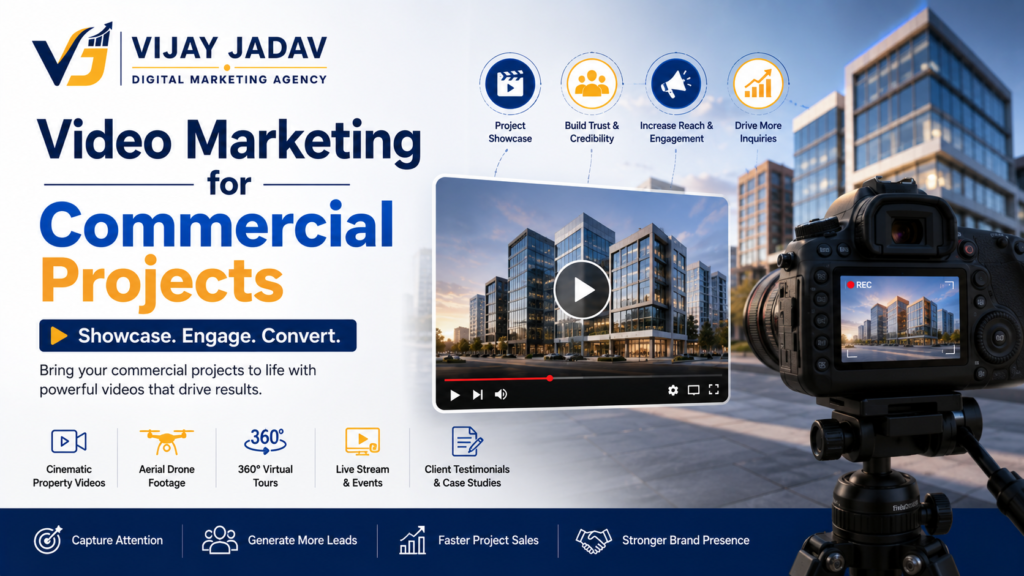
Video marketing is one of the most effective ways to showcase commercial real estate projects because it helps buyers visualize spaces, understand property features, and build confidence before scheduling a visit. High-quality videos improve engagement, increase inquiries, and strengthen brand credibility.
Commercial property buyers expect more than static images. They want to experience the property before investing their time in a site visit. Professionally produced videos create an emotional connection while presenting practical information such as layout, accessibility, nearby infrastructure, parking, security, and business potential.
Drone videos are particularly effective for showcasing business parks, industrial estates, logistics hubs, retail complexes, and office campuses. Aerial footage highlights surrounding roads, transportation networks, neighboring developments, and overall project scale. Interior walkthroughs demonstrate workspace layouts, meeting rooms, amenities, elevators, reception areas, and common facilities.
Short-form videos optimized for LinkedIn, YouTube, Instagram, and Facebook help increase reach while driving traffic back to your website. Educational videos discussing investment opportunities, market trends, leasing tips, or commercial property regulations position your company as a trusted industry expert rather than simply a property seller.
Video testimonials from satisfied clients further strengthen credibility. Hearing investors or business owners describe their positive experiences creates social proof that written reviews alone cannot provide. Case study videos showing successful commercial developments also help build long-term trust.
To maximize SEO value, upload videos with keyword-rich titles, descriptions, transcripts, and structured data. Embedding videos on relevant landing pages can increase time on site, reduce bounce rates, and improve overall user engagement.
A consistent video marketing strategy not only generates more leads but also supports AI-powered search platforms by providing rich, multimedia content that answers user questions more effectively.
Video Type | Primary Goal |
Property Walkthrough | Showcase features |
Drone Footage | Display project scale |
Virtual Tour | Remote property viewing |
Client Testimonials | Build trust |
Market Updates | Demonstrate expertise |
Investment Guides | Educate potential investors |
Lead Nurturing Strategies That Actually Work
Lead nurturing is the process of building relationships with potential buyers and investors through personalized communication until they are ready to make a decision. In commercial real estate, consistent follow-up using email, WhatsApp, CRM systems, and educational content significantly increases conversion rates and shortens the sales cycle.
Generating leads is only the beginning of a successful commercial real estate marketing strategy. Many prospects do not purchase or lease a property immediately because they need time to evaluate budgets, locations, business requirements, and investment potential. Companies that stay connected with prospects throughout this decision-making journey are more likely to convert inquiries into long-term clients.
An effective lead nurturing strategy begins with proper lead segmentation. Separate prospects based on their interests, such as office spaces, retail outlets, warehouses, industrial properties, or investment opportunities. This allows businesses to send highly relevant updates instead of generic promotional messages. Personalized communication improves engagement and demonstrates that you understand each prospect’s specific needs.
Email marketing remains one of the most reliable nurturing channels. Share new property launches, market reports, investment insights, leasing opportunities, and success stories on a regular schedule. WhatsApp Business can complement email by providing quick responses, property brochures, appointment confirmations, and site visit reminders. However, avoid excessive messaging that may discourage potential clients.
Marketing automation further strengthens lead nurturing. Automated workflows can send welcome emails, follow-up reminders, downloadable investment guides, and personalized property recommendations based on user behavior. CRM software also helps sales teams track interactions, schedule follow-ups, and prioritize high-intent leads.
Educational content is equally important. Instead of constantly promoting listings, publish blogs, FAQs, commercial investment guides, and neighborhood analysis that help prospects make informed decisions. This approach builds trust, positions your business as an industry expert, and aligns with Google’s EEAT principles.
Lead Nurturing Method | Business Benefit |
Email Campaigns | Consistent communication |
WhatsApp Follow-ups | Faster responses |
CRM Automation | Better lead management |
Personalized Recommendations | Higher engagement |
Educational Content | Builds trust and authority |
Retargeting Ads | Re-engages interested visitors |
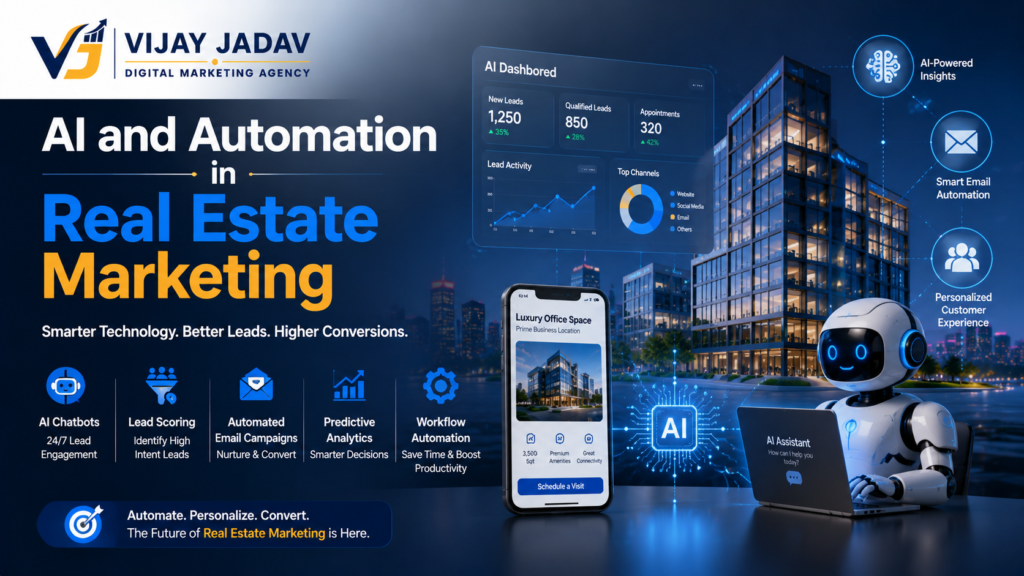
AI and Automation in Real Estate Marketing
AI and marketing automation help commercial real estate companies improve efficiency by automating repetitive tasks, analyzing customer behavior, personalizing campaigns, qualifying leads, and delivering faster responses. These technologies save time while improving lead quality and customer experience.
Artificial intelligence has become one of the biggest competitive advantages in commercial real estate marketing. Instead of relying solely on manual processes, businesses now use AI-powered tools to understand customer preferences, predict buying intent, and optimize marketing campaigns based on real-time data.
AI chatbots are among the most widely adopted technologies. They answer frequently asked questions, collect visitor information, recommend suitable properties, schedule appointments, and provide instant assistance even outside business hours. This improves customer satisfaction while ensuring that no valuable inquiry goes unanswered.
Predictive analytics is another powerful application. AI analyzes historical customer behavior, website activity, search patterns, and engagement levels to identify which prospects are most likely to convert. Sales teams can then focus their efforts on high-quality opportunities instead of spending time on low-intent leads.
Marketing automation platforms streamline repetitive tasks such as email campaigns, lead scoring, social media scheduling, and follow-up reminders. Instead of manually contacting every prospect, businesses can create automated workflows that deliver personalized messages based on customer actions, saving significant time while maintaining consistent communication.
AI also improves content marketing by identifying trending topics, optimizing headlines, suggesting keywords, and analyzing content performance. While AI accelerates content creation, human expertise remains essential for ensuring accuracy, originality, and compliance with Google’s EEAT guidelines.
As AI technology continues evolving, companies that combine automation with genuine human expertise will deliver better customer experiences, stronger relationships, and more sustainable business growth.
AI Technology | Practical Use Case |
AI Chatbots | 24/7 customer support |
Predictive Analytics | Lead scoring |
Marketing Automation | Email & follow-up workflows |
AI Content Tools | SEO content assistance |
CRM Automation | Lead tracking |
AI Reporting | Campaign performance analysis |
KPIs Every Real Estate Company Should Track
Key Performance Indicators (KPIs) help commercial real estate businesses measure marketing performance, improve decision-making, and maximize return on investment. Tracking metrics such as lead generation, conversion rates, website traffic, and cost per acquisition ensures marketing budgets are invested effectively.
Without accurate performance measurement, it is impossible to determine whether a marketing campaign is successful. Commercial real estate companies should regularly monitor data from Google Analytics, Google Ads, CRM platforms, social media channels, and marketing automation software to evaluate business growth.
One of the most important KPIs is qualified lead generation. Instead of measuring only the total number of inquiries, businesses should focus on prospects who match their target audience and have genuine purchasing or leasing intent. Higher-quality leads typically produce better conversion rates and improved sales efficiency.
Website traffic is another valuable metric. Analyze where visitors come from, which pages receive the most engagement, how long users stay, and which content generates inquiries. These insights help identify opportunities to improve SEO, content strategy, and user experience.
Cost Per Lead (CPL) and Cost Per Acquisition (CPA) help evaluate advertising efficiency. If campaigns generate many clicks but few qualified leads, adjustments may be needed in targeting, messaging, or landing page optimization. Monitoring Return on Ad Spend (ROAS) also ensures advertising budgets produce measurable business value.
Other important KPIs include email open rates, click-through rates, appointment bookings, occupancy rates, customer retention, and overall revenue generated from digital marketing efforts. Regular reporting enables businesses to identify trends, optimize campaigns, and make informed strategic decisions.
KPI | Why It Matters |
Website Traffic | Measures online visibility |
Qualified Leads | Indicates lead quality |
Conversion Rate | Evaluates sales performance |
Cost Per Lead | Measures campaign efficiency |
Return on Ad Spend | Tracks advertising profitability |
Customer Lifetime Value | Measures long-term business value |
Successful companies review KPIs monthly and use the insights to refine marketing strategies, improve customer experiences, and achieve sustainable growth.
Choosing the Right Digital Marketing Partner
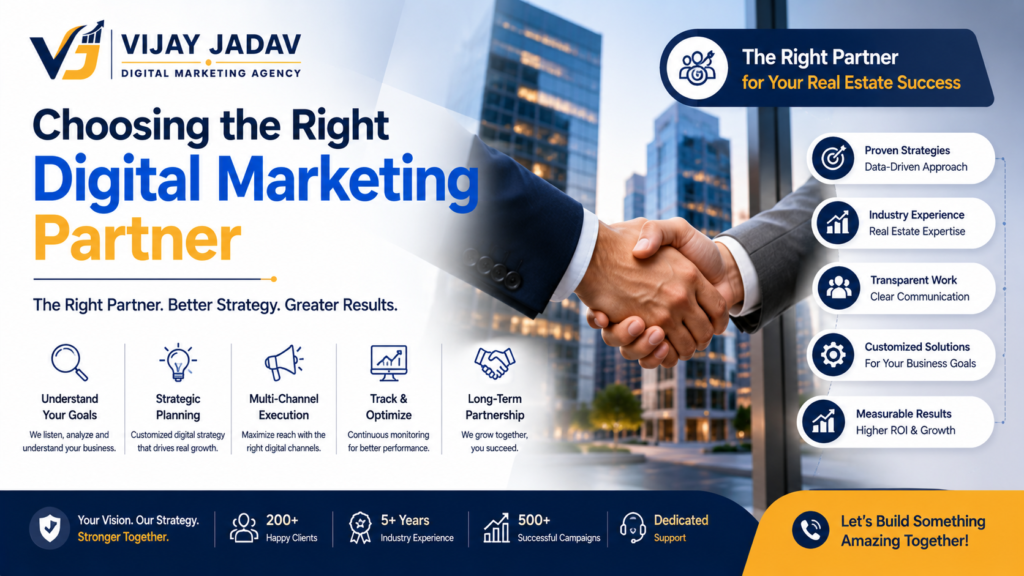
Choosing the right digital marketing partner requires evaluating industry experience, proven results, transparency, communication, technical expertise, and long-term strategy. A reliable agency should focus on generating qualified leads and measurable business growth rather than simply increasing website traffic.
Selecting a digital marketing agency is a strategic business decision that directly impacts your brand visibility, lead generation, and revenue growth. Commercial real estate marketing requires specialized knowledge because the buying journey is longer, investment values are higher, and decision-makers expect detailed information before taking action.
Begin by reviewing the agency’s portfolio and case studies. Look for experience working with real estate developers, commercial property consultants, leasing firms, or investment companies. Agencies that understand the commercial real estate industry are better equipped to create targeted campaigns, optimize landing pages, and develop content that addresses investor concerns.
Transparency is another critical factor. A trustworthy agency should clearly explain its SEO strategies, advertising approach, reporting methods, and expected timelines. Avoid partners that promise guaranteed first-page rankings or unrealistic lead numbers without supporting evidence. Sustainable digital marketing focuses on continuous improvement rather than shortcuts.
Communication also plays an essential role. Regular performance reports, strategy meetings, and campaign updates ensure both parties remain aligned on business goals. Agencies should be proactive in recommending improvements based on campaign data, changing market conditions, and evolving search engine algorithms.
Finally, choose a partner that offers a comprehensive digital marketing solution, including SEO, Google Ads, LinkedIn Ads, content marketing, website optimization, local SEO, marketing automation, analytics, and conversion rate optimization. An integrated strategy delivers better long-term results than isolated marketing efforts.
Evaluation Factor | What to Look For |
Industry Experience | Commercial real estate expertise |
Proven Results | Case studies and testimonials |
Transparency | Clear reporting and communication |
Technical Skills | SEO, PPC, Analytics, Automation |
Content Expertise | EEAT-focused content strategy |
Long-Term Support | Continuous optimization and growth |
A strategic digital marketing partner becomes an extension of your business, helping you attract qualified investors, strengthen your online presence, and achieve sustainable growth in Ahmedabad’s competitive commercial real estate market.
Frequently Asked Questions
Commercial real estate digital marketing is the process of promoting office spaces, retail properties, warehouses, and commercial projects through SEO, Google Ads, social media, content marketing, email campaigns, and AI-powered automation to generate qualified leads and increase property sales or leasing.
SEO helps commercial real estate companies rank higher on Google for relevant property searches, attract high-intent investors and tenants, improve website traffic, and generate long-term organic leads without relying solely on paid advertising.
Yes. Google Ads is highly effective because it targets users who are actively searching for commercial properties, office spaces, warehouses, or investment opportunities. Well-optimized campaigns can generate high-quality leads and measurable ROI.
AI helps automate lead qualification, personalize marketing campaigns, analyze customer behavior, improve follow-up communication, optimize advertising performance, and provide instant customer support through AI chatbots, making marketing more efficient and effective.
A professional website should include detailed property listings, high-quality images, virtual tours, floor plans, location maps, investment information, lead capture forms, clear calls-to-action, customer testimonials, and mobile-friendly design to improve conversions.
Choose an agency with proven experience in commercial real estate marketing, strong SEO and PPC expertise, transparent reporting, successful case studies, content marketing capabilities, and a data-driven strategy focused on generating qualified leads and long-term business growth.